
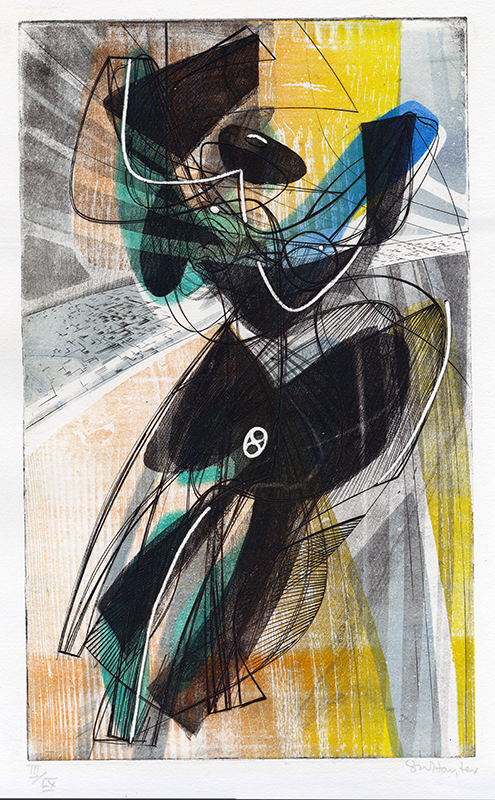
Danse du soleil is an intaglio created by Stanley William Hayter in 1951. The reference for this work is Black & Moorhead 197 and it is from the fifth and final state. Danse du soleil is a complex intaglio that includes engraving, soft ground etching and scorper, with colors offset from wood through stencil or rolled through stencil. This impression is pencil signed and editioned III/LX and is from printing A that was distributed to England. This impression was printed by the artist and Atelier 17 on Arches wove with partial watermark. The platemark measures 15-1/2 x 9-3/8 inches.
An on-line search found no two examples of Danse du soleil with the exact coloring. The different printings (a and b) had intaglio black and orange but the color gradations were quite different. Hayter used a scorper to gouge the plate, the result being three-dimensional white highlights.
Stanley W. Hayter was born in Hackney, England in 1901. After three years working as a chemist in the oil fields of Iran, he enrolled in the Académie Julian in Paris in 1926. There he met the engraver Joseph Hecht and began to merge chemistry with printmaking.
In 1927, Hayter founded Atelier 17, an experimental graphic arts workshop in Paris that played a central role in the revival of the print as an independent art form. European artists came to work with him and ideas flowed freely. Hayter left Paris in late 1939 as war closed in on the city.
Hayter opened Atelier 17 in 1940 in New York and the studio became a melting pot of European artists who had fled the war and American artists, many who had worked in the printmaking section of the WPA. The emphasis was on experimental color printing, including the use of viscosity printing and offset color using screenprint, stencil and woodcut.
Hayter returned to Paris in 1950 and reopened Atelier 17, attracting many artists from Asia. He continued to experiment with color printing, including the use of Flowmaster pens, incongruous and fluorescent colors, and flowing, interwoven patterns. With an unrivaled knowledge of the technicalities of printmaking, Hayter authored two major books, New Ways of Gravure and About Prints.

