
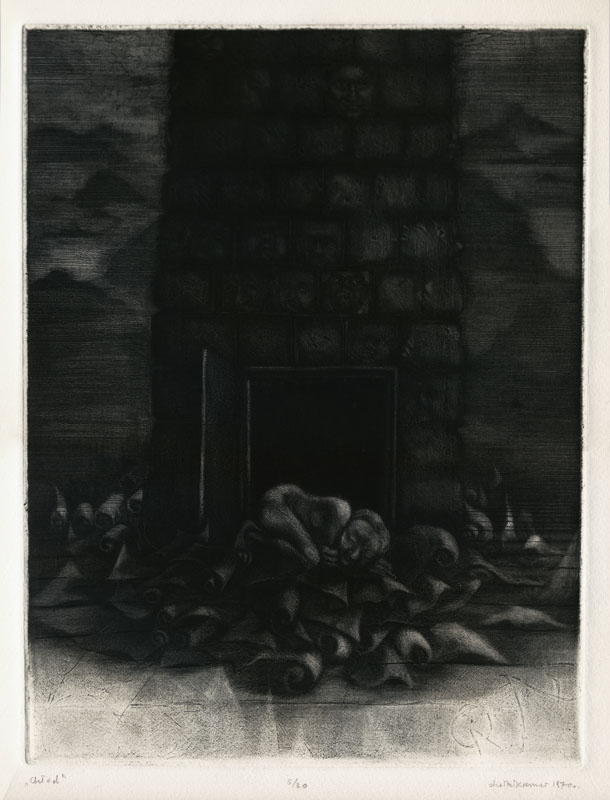
Chlod is a mezzotint and etching created in 1970 by Polish artist Marta Kremer. It is pencil signed, titled, dated and editioned 5/30. The reference is Kremer Graphics no. 23. Chlod is printed on ivory wove paper and the platemark measures 12-11/16 x 9-5/8 inches platemark.
Chlod (Coldness) captures the sense of isolation and loneliness of a child in a time of great societal struggle but, with Kremer’s choice of mezzotint to soften the atmosphere of the scene, it is not without beauty. A naked figure lies on a pile of rolled fabrics, a cold hearth and a stone chimney with ghostly faces emerging rise behind her. In a sense, the artist seems to hold her childhood self in a nest of safety that defies the truth of the outside world. The artist witnessed the results of the brutality of Nazism and the strictures of Communism in Poland. Her mezzotint transcends its original era. The imagery of displaced innocence, cold boundaries, and names lost to systemic cruelty mirrors the modern plight of refugees and migrants facing hostile border crossings and detention camps today. Perhaps Kremer presented those ghostly faces so that history cannot easily look away. Until humanity learns to extend its “nest of safety” to those outside its immediate borders, works like Chlod will unfortunately remain not just historical records, but active mirrors of our world.
Marta Kremer,
painter and printmaker, was born in Krakow, Poland, on February 21, 1941, during
the Nazi occupation. Following the war, Soviet rule stifled much of Poland's
artistic output with works often scrutinized by censors on the lookout for
anti-Communist sentiment. Kremer spent much of her childhood at home due to a
weak heart and frequent illnesses. As a result of the times, Kremer's earliest
memories are dark, filled with uncertainty and fear. This is a period in her
life that she has drawn from throughout her career as an artist.
After graduating from the Academy of Fine Arts in Krakow in 1966, Kremer began
exhibiting and her work gained recognition from Austrian and German art
critics. The Albertine Museum acquired one of her early prints and she has
since been included in several permanent collections. She participated in more
than seventy exhibitions throughout Europe, the Nordic region, England, and
South America. In December of 1975, Kremer moved to New York at the invitation
of the Polish cultural organization, the Kosciuszko Foundation, and worked and
exhibited in Manhattan for a year. She then relocated to West Virginia and in
1985 she became a naturalized citizen of the United States.
Kremer continued to work from her home and she exhibited internationally, receiving
awards and travel grants. In 1991, she was able to visit Poland following the
fall of communist rule and, in 1998, she returned permanently. That same year
she had a solo exhibition of her paintings at the Gologoeskieog Gallery at the Polonia
House in Warsaw. Kremer continues to work and there is a video of her
inking and wiping her etching plate on YouTube. In 2024, she had an exhibition
of paintings and prints that celebrated the 100th anniversary of the
death of Franz Kafka.

