
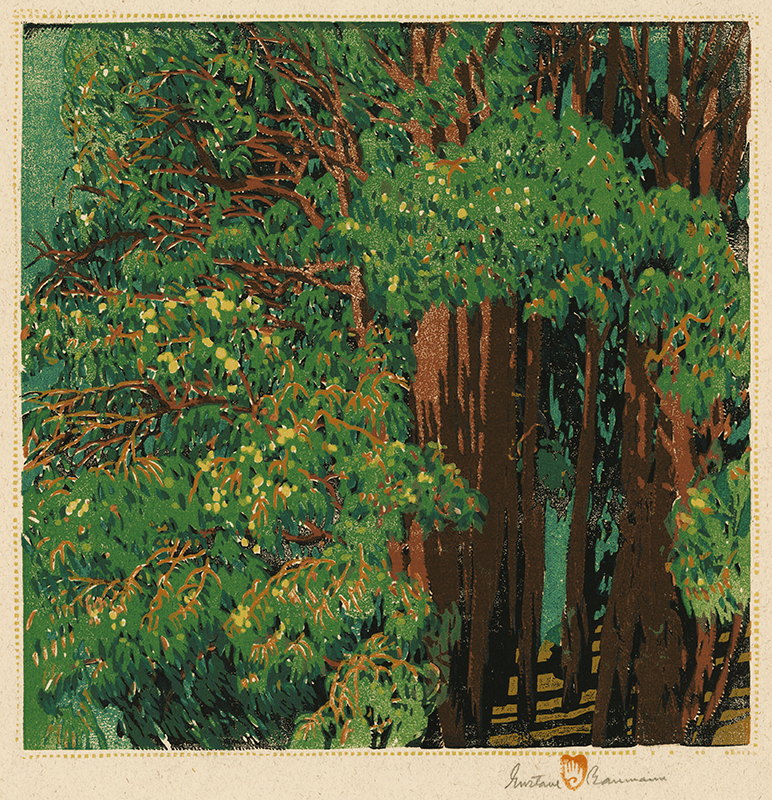
Singing Woods is a color woodcut by American master printmaker Gustave Baumann that originated in 1928. This impression was printed by the artist in 1967 when he printed impressions for an edition of twenty. Most impressions from this late edition are unnumbered proofs. Baumann printed his woodcut on cream wove Ansbach paper. The reference is Chamberlain 128 and the image measures 12-7/8 x 12-7/8 inches.
Singing Woods is one of several woodcuts Baumann created after his auto trip from Santa Fe to the coastline of California in April 1928. He wrote home to his wife, Jane, from Laguna Beach, California:
—well either I am crazy or I was crazy last year or this part of Cal. is really different from the Los A. [Angeles] blight further north—its Eucalyptus trees are a different variety from those in Phoenix still more lacy and with the full moon shining through them. I almost enthused but I’ll reserve that until the stuff is tucked into my portfolio—two weeks of flops make me a suspicious woman.
Baumann carved a total of eight basswood blocks for Singing Woods which are currently in the Herbert F. Johnson Museum of Art at Cornell University. They also have two sets of progressive proofs which indicate how the artist altered his imagery by substituting one black block for another. Changes to the blocks also reshaped the tree trunks and the pitch of the land in the rightmost third of the image.
Gustave Baumann was born in Magdeburg, Germany on 27 June 1881. Ten years later his family immigrated to the US, settling in Chicago. In 1896, Baumann began working in the commercial art field while saving money to study in Germany. After returning from Munich in December 1905 where he studied at the Kunstgewerbeschule, Baumann worked again in commercial art to support his family. In 1909, he discovered Brown County, Indiana where life was inexpensive and he could stay for three months. He produced a series of small format color woodcuts featuring the people and places of Brown County and then produced five large format color woodcuts. His woodcuts were accepted by the committee for the 1915 Panama Pacific International Exposition and he won a gold medal in 1916. Baumann headed east to Wyoming, New York in 1917 and taught at a summer school. From there he headed to Provincetown and New York City before returning to set up his studio in Wyoming. The southwest beckoned and he headed west in May 1918, stopping in Taos for the summer and fall. His funds were low and he needed to head back to Chicago but first stopped at the new art museum in Santa Fe to see an exhibition of his woodcuts. The rest, they say, is history.

